
Product
Boulder · New Mexico · United Kingdom
Products / VCSEL
VCSEL
Vertical-cavity surface-emitting lasers, characterized and qualified in-house. This is the one area where we publish performance results and where product is available today.
Wavelength
Wavelength, held against the line it targets
Characterized samples are built on a mesa 25 µm across with a 3 µm aperture, centered on an etalon wavelength of 791.5 nm, and tested at 25°C and 80°C under drive currents of 0.8, 1.5 and 2.2 mA. The trace above comes off that same bench: real LIV and wavelength data, not a datasheet figure.
That target is not arbitrary. Rubidium's D1 transition sits at 794.98 nm, and it is what our atomic sensors need to interrogate. A separate line of high-power multijunction VCSELs, at 905 nm and 940 nm, targets automotive sensing instead — a different wavelength for a different physics.
Characterization
Characterized and qualified in-house
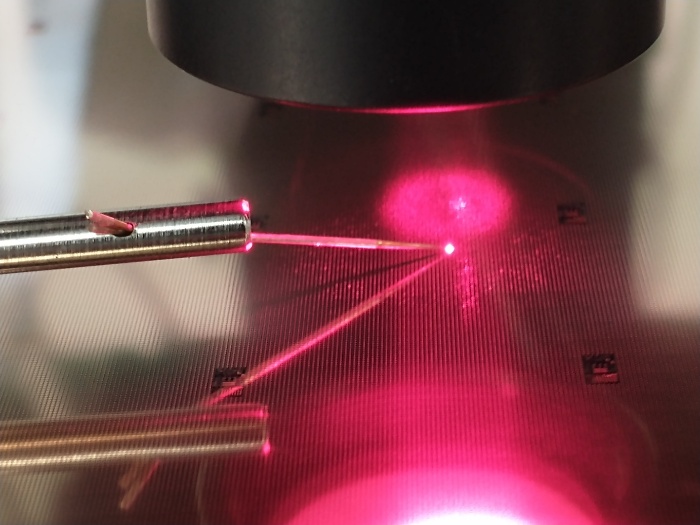
An automated test and scan setup takes VCSEL characterization from a bench process to a repeatable one. Devices are probed at wafer level, so a result is attached to a die rather than to a package, and the same measurement can be run across a whole wafer without a person moving a probe by hand.
That matters more than it sounds. A quantum sensor is only as reproducible as the light source inside it, and a light source is only as reproducible as the test that qualified it.
Supply
Working with us
Performance results, qualification data and what is available are shared directly. Tell us the wavelength and the environment the part has to survive, and we will tell you what we can do.